


The University of Namibia (UNAM) has handed over newly developed and protected spring infrastructure to three villages in the Kunene Region, giving rural communities better access to clean, safe water.
The official commissioning and handover ceremony took place on 28 October 2026 at Okorosave Spring. The Kunene Springs Project seeks to improve the protection and sustainable utilisation of groundwater resources in water-scarce rural communities.
The project, implemented by UNAM in collaboration with the Ministry of Agriculture, Fisheries, Water and Land Reform (MAFWLR), and in partnership with the SADC Groundwater Management Institute (SADC-GMI), focuses on the development and protection of springs in Okorosave, Otuzemba and Okaokotavi. It combines scientific research, stakeholder engagement and infrastructure development to address challenges associated with groundwater availability and water contamination.
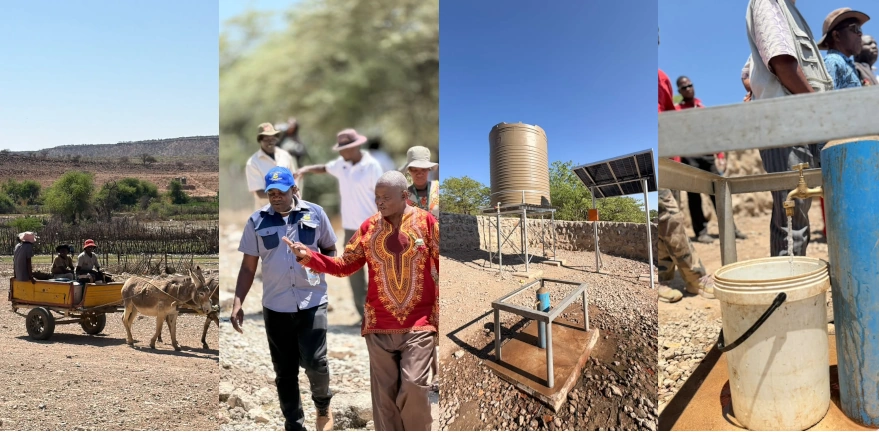
Through the intervention, the spring sources have been protected against contamination, while storage tanks and reservoirs, pipelines, solar-powered pumps and communal water taps have been installed to improve water access. The infrastructure is designed to ensure that both people and livestock have access to water without sharing the same abstraction point.
Speaking on the scientific objectives of the project, Dr. Innocent Muchingami from UNAM’s Department of Geosciences explained that the research goes beyond identifying and developing water sources, focusing also on understanding the underlying groundwater systems and how springs function.
He noted that the researchers are investigating how water flows beneath the surface, the geological conditions influencing the occurrence of springs and how contamination can be prevented at the source.
Groundwater at the heart of rural livelihoods
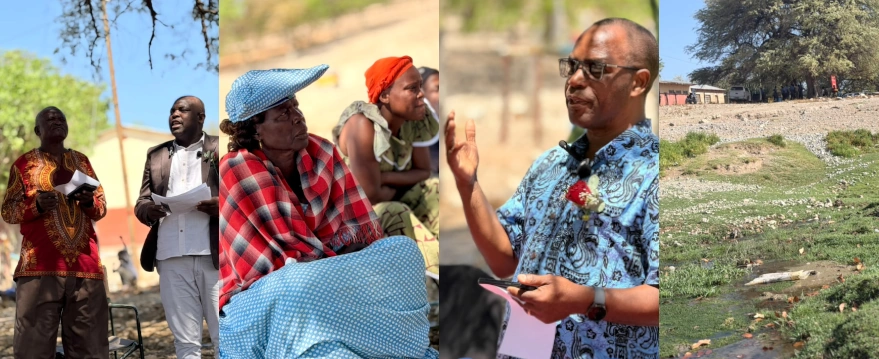
Mr. Sakeus Ihemba, Deputy Director of the Geohydrology Division in MAFWLR, said the project had made water safer and easier to reach for rural communities.
“This project made water safe to use for the community and ensured that clean water is brought closer to the community,” he said.
Delivering the keynote address, Eng. James Sauramba, Executive Director of SADC-GMI, spoke about the role of groundwater in rural livelihoods across Africa.
He noted that approximately 75% of people in rural communities across Africa depend on groundwater, mostly drawn from springs and boreholes, which makes protecting and managing this resource sustainably essential.
Eng. Sauramba said the initiative could serve as a model for other countries in the region, adding that SADC-GMI plans to upscale the project and share lessons from its implementation in Namibia with other African countries.
Representing the Office of the Vice-Chancellor, Prof. Jacob Sheehama, Campus Director of the Hifikepunye Pohamba and Oshakati Campuses, spoke about what the new infrastructure means for the three beneficiary villages.
“Today, we hand over protected spring infrastructure that will provide clean, potable water to three villages: Okorosave, Otuzemba and Okaokotavi. The project has protected the spring sources from contamination, so that water is captured clean at its origin,” he said.
Prof. Sheehama indicated that more than 5,000 residents per community, together with their livestock, are expected to benefit directly from the intervention.
Training the next generation of geoscientists
The project has also created opportunities for postgraduate research and practical training in geosciences, allowing students to contribute to scientific investigations while gaining exposure to real-world groundwater challenges.
One such student is Tuutaleni Angula, who joined the Kunene Springs Project in 2025 after receiving a project scholarship to pursue a Master of Philosophy in Geosciences at UNAM.
Angula said the project has given her the chance to take part in field investigations, collect and analyse data, attend training programmes and conferences, and engage with other researchers.
“One of the most memorable parts of this experience has been seeing the springs developed to provide communities with easier access to clean water. Having spent time in the field investigating these springs, seeing water flowing from the newly installed taps means a great deal to me,” she said.
She added that seeing fieldwork turn into working taps has shown her that research can do more than produce academic papers; it can improve the lives of people who depend on groundwater.
The project also acknowledges the contribution of UNAM’s Department of Geosciences project management team based at the Southern Campus in Keetmanshoop, particularly Dr. Josefina Hamutoko, Dr. Innocent Muchingami and Ms. Hatago Stuurmann, who managed the implementation of the initiative.
The Kunene Springs Project brought university research, government partners and local communities together to meet a basic need: clean water. By protecting groundwater sources and building the infrastructure around them, UNAM is contributing to sustainable water management, research capacity and better livelihoods in rural Namibia.
The project forms part of the broader Sustainable Groundwater Management in SADC Member States Programme, generously funded by the Global Environment Facility (GEF) and the Cooperation in International Waters in Africa (CIWA) Multi-Donor Trust Fund, through the World Bank.