


Outside the entrances of two of Windhoek’s busiest hospitals, patients hurrying to appointments were stopped by students in scrubs and pink ribbons with a simple question: how much do you know about breast cancer?
The Breast Cancer Awareness Initiative brought together students and lecturers from Radiography, Nursing, Physiotherapy, Occupational Therapy and Psychology in UNAM’s Schools of Allied Health Sciences and Nursing. For two days, they set up at Windhoek Central Hospital and Katutura Intermediate Hospital to tackle a pressing problem: too many breast cancer cases in Namibia are detected late, because of gaps in awareness, misconceptions and limited access to screening.
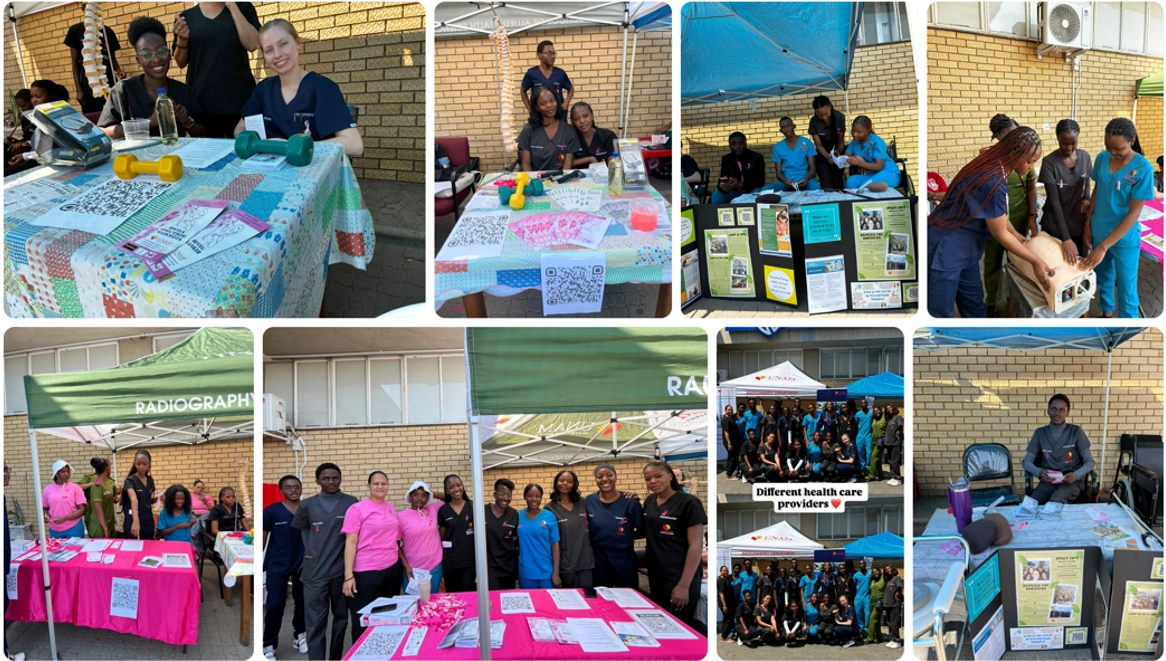
Five stations, one journey
Visitors moved through five stations. Radiography students explained mammography, ultrasound and radiation safety; Physiotherapy students demonstrated exercises; Occupational Therapy students showed low-cost assistive devices for life after surgery; Psychology students shared ways to cope with stress and anxiety; and Nursing students conducted clinical breast examinations in a private area. People eligible for screening were referred for mammograms at the UNAM Radiology and Diagnostic Imaging Centre (URADIC).
Each station was led by a student from its own discipline, guiding peers from the other four. “This initiative marks a successful first interprofessional community engagement project for the Schools of Allied Health Sciences and Nursing,” reflected organiser Dr. Luzanne Kalondo of the Department of Radiography.
In their feedback, students described what the two days taught them. A Radiography student realised that imaging is only one part of cancer care, and that patients still have a long road ahead after leaving the department. A Physiotherapy student saw how they could promote early awareness and refer patients to the wider team, while Occupational Therapy students valued explaining their profession and displaying assistive devices. Another student learnt how to do a physical breast examination and what to look for. One student likened the different programmes to pieces of a puzzle that come together, saying it was refreshing to learn how important the School of Allied Health Sciences is to society.
Of the 28 students who completed a feedback survey, all said the campaign strengthened their understanding of their own profession’s role and their confidence in sharing health information. Several also learnt that breast cancer affects men as well as women. Language barriers and busy patients proved real hurdles, and future editions may move to shopping malls, clinics and other UNAM campuses, and add prostate and cervical cancer awareness.
The initiative took place on 28 and 29 September 2026, ahead of Breast Cancer Awareness Month in October. “A special thank you goes to the dedicated healthcare students whose leadership, hard work at the stations and profound commitment to community service drove the overall success of this initiative,” Dr. Kalondo acknowledged.