


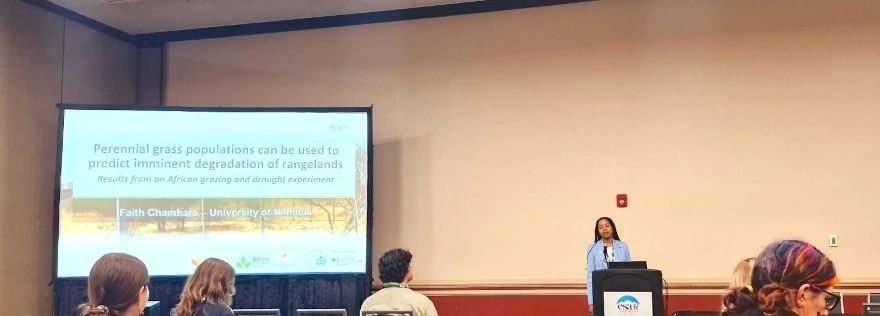
A five-year study into how drought and grazing are reshaping Namibia’s rangelands has reached an international audience, with UNAM PhD graduate Dr. Faith Chambara presenting her findings at the Ecological Society of America (ESA) Annual Meeting in the United States.
Dr. Chambara, from the Department of Environmental Science, conducted the research under the guidance of Dr. Wellencia Nesongano, Principal Investigator of the NamTip Project. She joined more than 2,600 ecologists from around the world at the conference, held under the theme “Ecology in an Era of Uncertainty.”
Her long-term experiment tracked how repeated droughts and intensive grazing are gradually depleting key forage species in Namibian rangelands, while also revealing the resilience of certain native plants able to withstand harsh conditions.
“It was encouraging to see how strongly the research resonated with scientists working in dryland regions globally, where many face similar environmental challenges,” Dr Chambara said.
She stressed the need for sustained investment in long-term ecological research, particularly restoration experiments that test how well these systems can recover. “This kind of research gives us critical insights for sustainable land management, ecosystem restoration, and the livelihoods of communities that depend on dryland ecosystems,” she said.
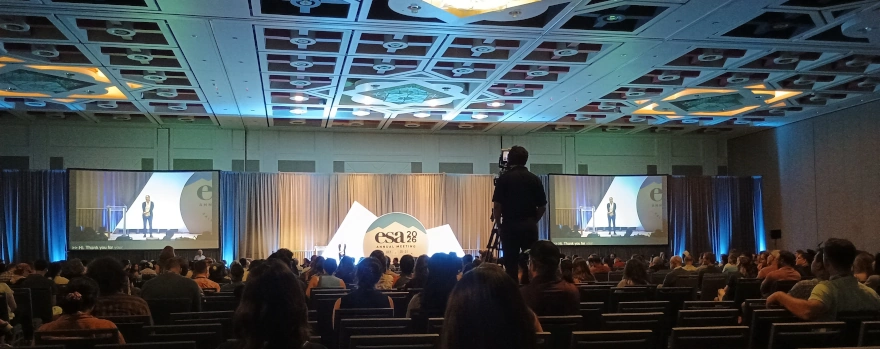
Beyond her presentation, Dr Chambara attended scientific sessions and plenary discussions, and used the opportunity to broaden her international research network.
The ESA Annual Meeting is a leading forum for ecological research, drawing scientists, educators, students, policymakers and practitioners from across the world to address environmental challenges and advance ecological knowledge. UNAM’s participation reflects its ongoing contribution to globally relevant research and its commitment to environmental challenges facing Namibia, Africa and the wider world. More information is available at www.esa.org.
The study formed part of the now-concluded NamTip project, a German-Namibian collaboration examining dryland ecosystem dynamics under shifting climatic conditions. With droughts growing more frequent and severe worldwide, such research offers vital knowledge for sustainable land management, biodiversity conservation and the long-term well-being of communities reliant on rangeland resources. More on the project is available at www.uni-potsdam.de/en/namtip .
The ESA Annual Meeting took place from 26 to 31 July 2026.