


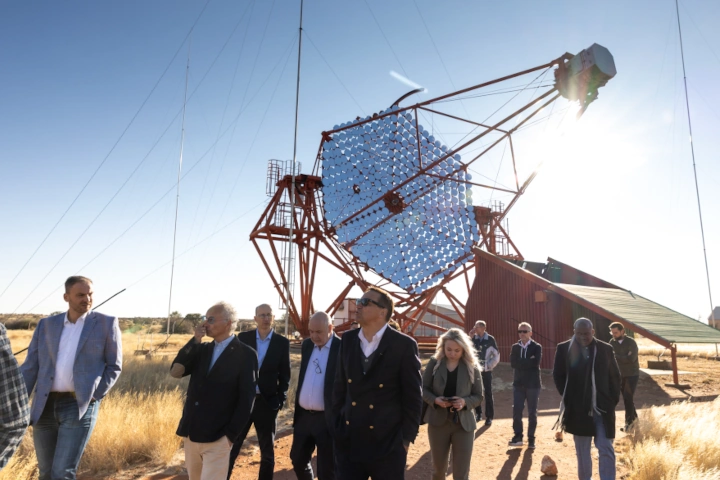
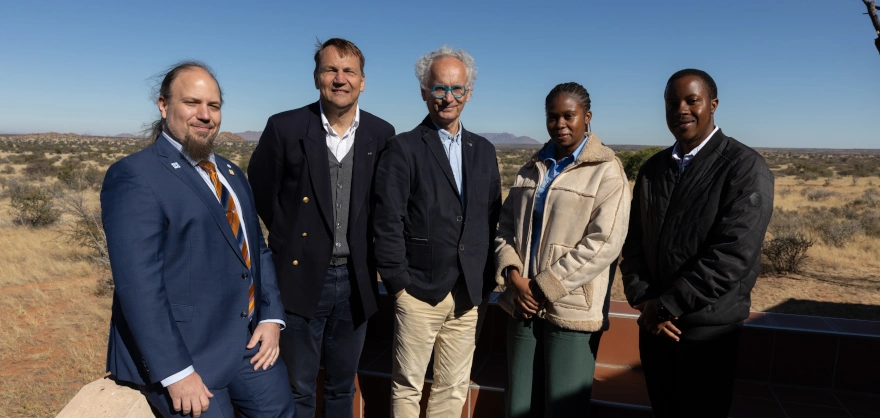
High in the Khomas Highlands, where some of the world’s most powerful telescopes scan the southern sky for gamma rays, UNAM astronomers welcomed a visitor from well beyond the world of science. On 01 July 2026, H.E. Radosław Sikorski, Deputy Prime Minister and Minister of Foreign Affairs of the Republic of Poland, led a high-level Polish delegation to the High Energy Stereoscopic System (H.E.S.S.).
The visit formed part of the Deputy Prime Minister’s official engagement in Namibia, which focused on investment, trade and economic cooperation. It also put the spotlight on a quieter area of partnership between the two countries: astronomy.
H.E.S.S. is one of the world’s leading very-high-energy gamma-ray observatories. It studies some of the most energetic phenomena in the Universe, including supernova remnants, pulsars, binary systems and active galaxies powered by supermassive black holes. Namibia’s location offers excellent observing conditions and access to the southern sky.
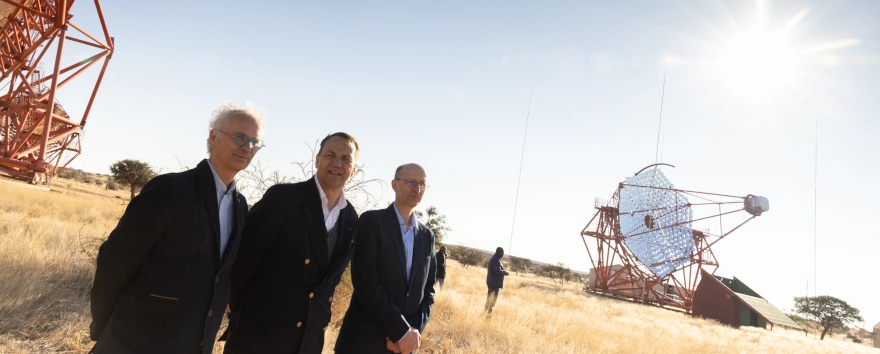
The international H.E.S.S. collaboration brings together scientists and institutions from 14 countries. UNAM is a founding member, while Poland has been active for 20 years through institutions such as the Nicolaus Copernicus Astronomical Center of the Polish Academy of Sciences in Warsaw and the Astronomical Observatory of the University of Warsaw.
The delegation toured the observatory and learnt how the telescopes operate, the science they enable and the collaboration behind them. They were joined by Prof. Rafał Moderski, Director of the Nicolaus Copernicus Astronomical Center and leader of the Polish H.E.S.S. group, and Prof. Tomasz Bulik, Director of the Astronomical Observatory of the University of Warsaw. Prof. Michael Backes, Head of Astrophysics Research at UNAM and of the Namibian H.E.S.S. group, accompanied the visitors.
“H.E.S.S. serves not only as a research platform, but also as a platform for education, diplomacy and international partnership,” said Prof. Backes. “While the telescopes are designed to observe the Universe at extremely high energies, the project itself depends on cooperation between people, institutions and countries.”
Growing Namibia’s own astronomers
Two UNAM PhD students in astrophysics, Tuwilika Simon and Hiiko Katjaita, also took part in the visit; a reflection of the role that student training and local capacity development play in Namibia’s growing astronomy landscape.
“Through its involvement in H.E.S.S., UNAM continues to create opportunities for Namibian students and researchers to participate in internationally recognised scientific work,” said Katjaita.
For UNAM, the visit was more than a tour of a scientific facility. It reaffirmed Namibia’s place within a network of world-class research and strengthened the country’s position as a destination for future astronomical facilities, such as the Africa Millimetre Telescope.
“With sustained involvement from UNAM and international partners, Namibia’s clear and pristine skies continue to support discoveries that reach far beyond its borders,” said Simon.
Written by Hiiko Katjaita & Tuwilika Simon.