


Namibia is setting its sights on the peaceful use of nuclear energy following the World Atomic Week in Moscow — a global event that brought together over 20,000 experts from 118 countries to explore how atomic technology can drive sustainable growth.
Held under the theme “From a New Technological Paradigm to a New Philosophy,” the event focused on energy diversification, domestic value addition of uranium, nuclear safety, and the peaceful industrial uses of atomic technology. It was attended by a high-level Namibian delegation comprising members of Parliament’s Natural Resources Committee, local community activists, and academics such as Dr Marius Johannes from the Namibia Business School.
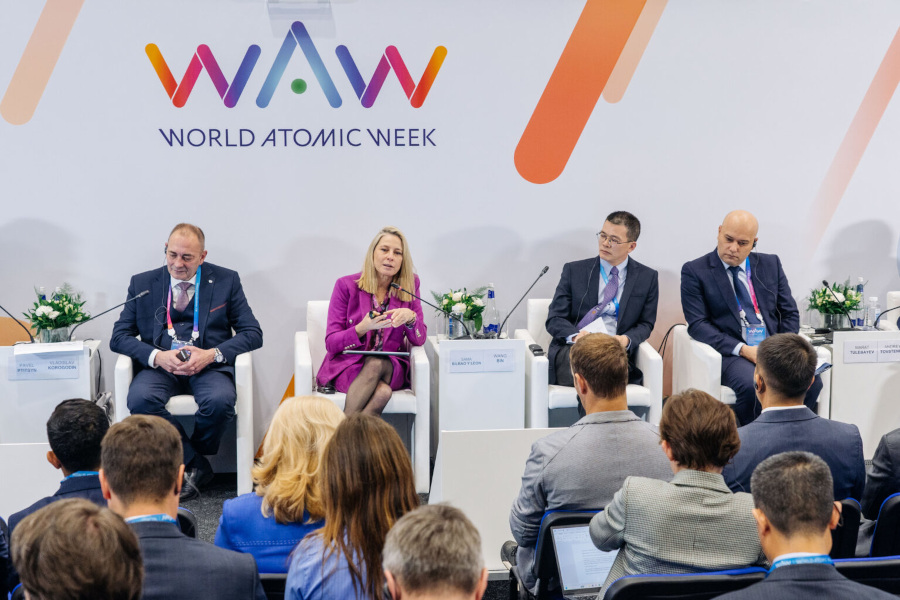
This encapsulates Namibia’s ambitions to industrialise and reduce poverty through science and innovation, an ambition that can be realised through the sustainable application of nuclear energy in industries such as mining, energy, health, and robotics, as showcased during the week-long forum. Reflecting on the event, Dr Johannes emphasised the progressive use of nuclear energy demonstrated throughout the World Atomic Week.
Innovative and Sustainable Mining
Namibia accounts for roughly 12% of the global uranium supply, with production surging to 7,300 tonnes in 2024. This positions the country among the world’s top three uranium producers and underscores a growing focus on sustainable mining methods such as in-situ recovery (ISR) – a cleaner and more cost-effective extraction technique.
The ISR method, showcased in Moscow, was presented as a safer and more sustainable alternative to traditional mining, now accounting for nearly 60% of global uranium production. Unlike open-pit or underground mining, ISR extracts uranium through pumped underground solutions, leaving geological formations largely intact. The technology could be a boon for Namibia’s sandstone-hosted deposits, creating local jobs while minimising environmental impact. However, experts caution that groundwater protection and strong regulatory oversight will be essential.
The Case for Clean Power
Namibia currently imports up to 70% of its electricity, primarily from South Africa; with power demand peaking around 600 MW. This dependence on regional suppliers costs the country nearly N$4 billion annually, which can be reduced by Small Modular Reactors (SMRs). These reactors, as showcased by BRICS nations at the forum, generate between 50 and 300 MW, designed for smaller grids. Rosatom also unveiled a floating nuclear power unit tailored for coastal regions. For Namibia, such innovations could support both electricity generation and desalination along its Atlantic coastline. Inspired by new BRICS cooperation frameworks, Namibia could follow the examples of Egypt and Niger in exploring nuclear partnerships that balance cost, safety, and sustainability.
Healing Through Science
The Moscow discussions also spotlighted nuclear medicine, a field with immense promise for Namibia’s healthcare system. Radiopharmaceuticals are revolutionising cancer treatment and diagnostics worldwide, with Russia performing nearly a million such procedures annually.
Namibia’s nuclear medicine facilities are expanding but demand far exceeds supply. By investing in isotope production and medical technology training, Namibia could not only improve healthcare access but also establish itself as a regional supplier. Developing a medical cyclotron or isotope production laboratory would reduce costly imports while creating highly skilled employment opportunities.
Digital and Human Capital Frontiers
Beyond reactors, Namibia’s delegation observed how artificial intelligence, robotics, and automation are reshaping nuclear and mining industries globally. A practice that local operations such as Husab Mine already employ by using remote-controlled loaders and automated rigs, boosting safety and productivity.
Embracing Industry 4.0 which could position Namibia as a leader in intelligent, efficient resource extraction required strategic collaboration with human capital frontiers such as higher education institution. Education will serve as the cornerstone of this transformation. Institutions such as UNAM and NUST must serve as catalysts for innovation through the introduction of modules in nuclear science, reactor physics, and radiopharmacy.
Africa and BRICS — Partnerships for Progress
Namibia’s potential nuclear journey mirrors a broader African movement. More than 20 African countries, from Kenya to Niger, are exploring atomic energy solutions. Through BRICS partnerships and IAEA cooperation, Namibia can access financing, technology transfer, and capacity building.
Additionally, collaborative training with Russia’s MEPhI and India’s Bhabha Atomic Research Centre could fast-track local expertise which can be realised through Russia’s Rosatom, China’s CGN, and South Africa’s Necsa willingness to assist. Joint ventures could extend to nuclear power plant feasibility studies, research reactors, and regional power-sharing projects.
A Vision for the Future
For policymakers, the roadmap is becoming clear: regulate responsibly, educate the public, and reinvest uranium revenue into research and human capital. Establishing a Nuclear Technology Development Fund could support scholarships, university laboratories, and pilot projects. The goal should be a future where Namibia powers its homes and industries with its own uranium, treats its citizens with locally produced isotopes, and leads Africa’s scientific advancement. If Namibia acts decisively, that future may arrive sooner than expected, glowing not from fossil fuels, but from the steady light of the atom.