


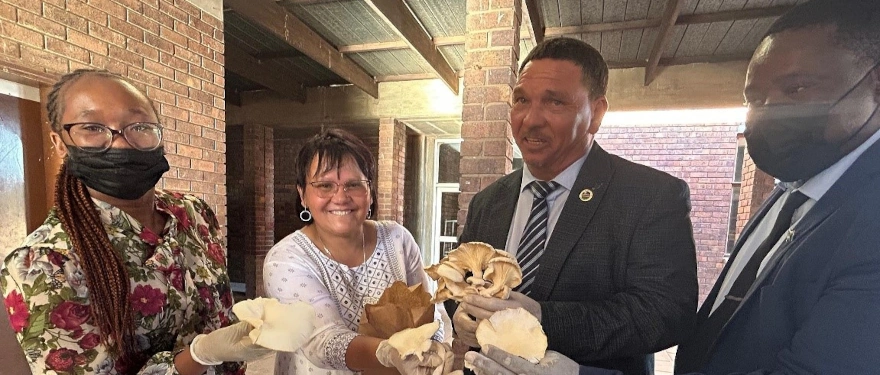
In a fruiting room in Schlip, Hardap Region, Grade 8, 9 and 10 learners are harvesting Golden Oyster mushrooms they grew themselves. Mentored by UNAM Cares at the University of Namibia, learners at Pionier Secondary School (PSS) are turning science into nutritious food, in step with this year’s World Food Day theme, “Innovate Today. Nourish Tomorrow”, marked on 16 October 2026.
The theme casts young people as innovators and leaders of a food-secure future.
The project follows UNAM Cares’ Sustainable One Health Agrifood Systems (SOHAFS) approach. “The Golden Oyster Mushroom cultivation is a powerful teaching tool because it connects the dots between food, nutrition, environmental sustainability, livelihoods and health. This is One Health in action, learning that connects people, food and the environment,” explained Prof. Rachel Freeman, Head of UNAM Cares.
Under the guidance of Ms. Isabella Ueitele, Bio Scientist at UNAM’s Multidisciplinary Research Service, learners are cultivating different mushroom species, taking their knowledge beyond the classroom and into practical food production. “Golden Oyster mushrooms are becoming more than a crop in the hands of these learners; they are becoming a lesson in science, nutrition, sustainability and possibility,” she observed.
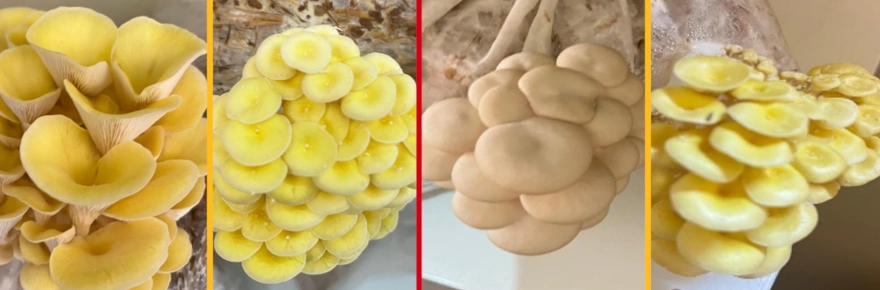
For the learners, the experience is both educational and empowering. “Before this, I thought mushrooms were something you only bought in a shop. Now I understand that I can produce food myself. I have learned that science can be practical and can help us solve problems in our communities,” shared a Grade 10 learner.
A Grade 9 learner sees opportunities beyond school: “Learning to grow mushrooms has made me think differently about food and entrepreneurship. What we are learning could become something we can use at home, share with our families or even turn into a small business.”
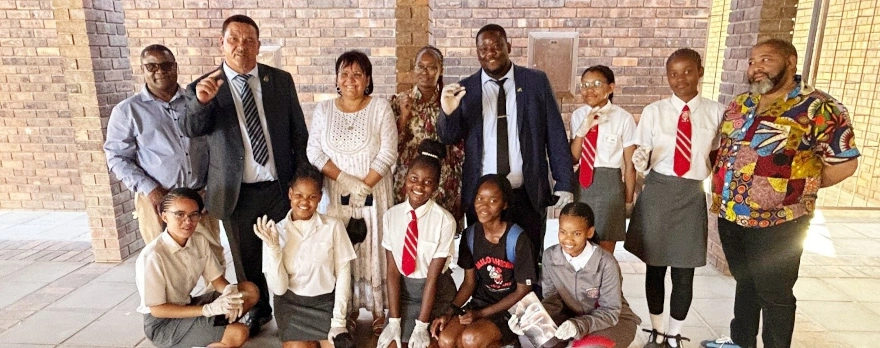
A visit from the Governor
On 15 October 2026, Governor Riaan McNab and Schlip Constituency Councillor Hon. Gustav Garoeb paid a courtesy visit to the school to learn about the project. Hon. McNab commended UNAM Cares for empowering young scientists in nutritious food production and noted that mushroom cultivation offers a chance to explore more circular approaches to food production.
For UNAM Cares, the greatest harvest is not measured only in kilograms. “When we empower a learner to grow food, we are planting much more than a seed. We are planting knowledge, dignity, innovation and hope. The mushroom may be small, but the possibilities it represents are enormous,” reflected Prof. Freeman.
The project reflects UNAM’s engaged-university model, in which knowledge leaves the classroom and laboratory to make a difference in communities, and young people become producers, innovators and entrepreneurs, not only consumers of food.
For partnerships with UNAM Cares, contact Prof. Rachel Freeman at rfreeman@unam.na or +264 81 252 0601.